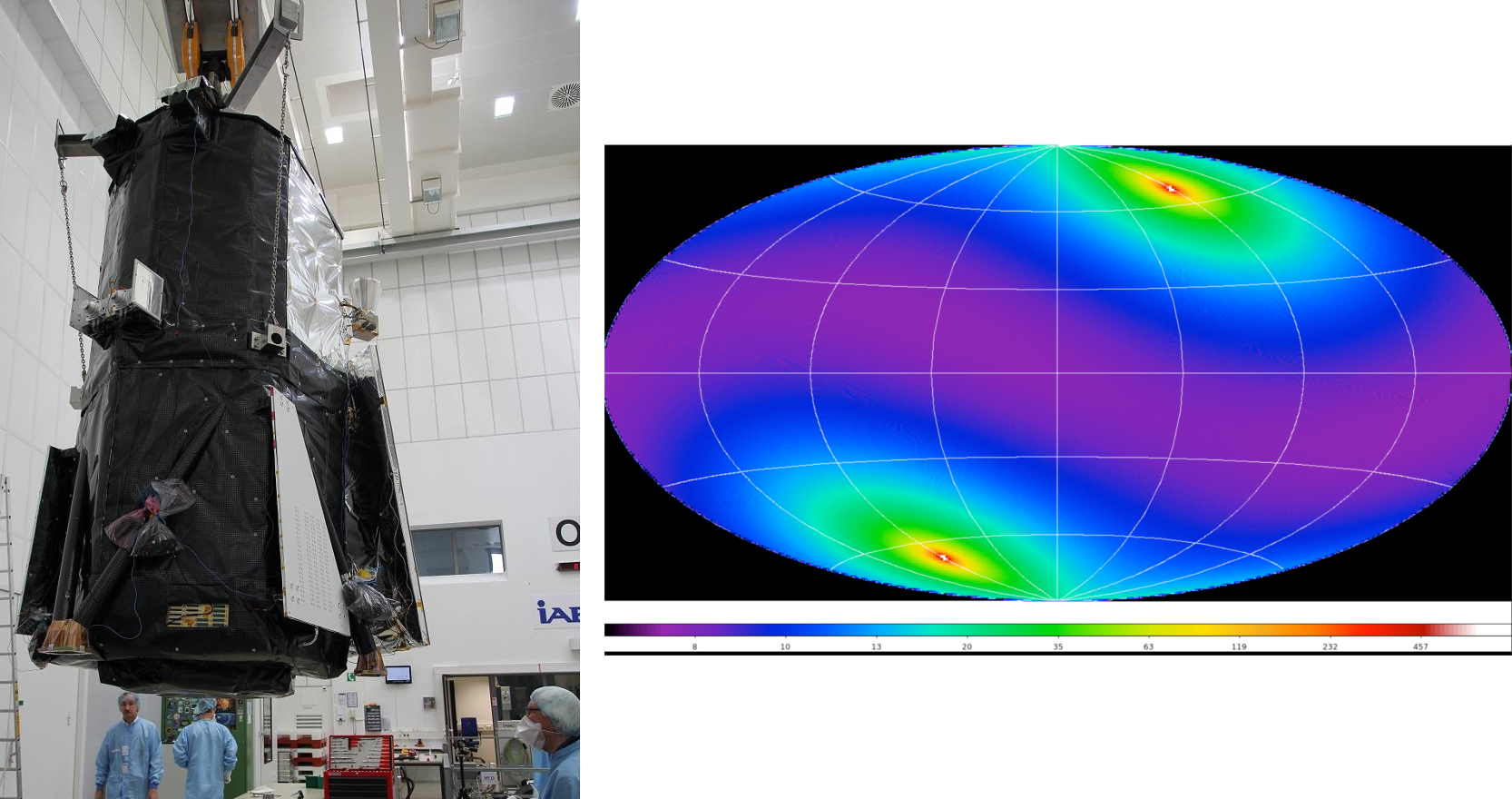
High Energy Astrophysics addresses among the most extreme processes and regions in the Universe. Plasma with temperatures up to billions of degrees, and the interaction of highly energetic electrons with magnetic and photon fields generates high energy radiation in the X-rays and gamma rays. Studying cosmic objects in these wavebands gives insights into physical processes that often cannot be achieved when observing in other wave bands.
The High Energy Astrophysics group at MPE, comprising about 80 members, has its major scientific emphasis on the study of these processes, mostly via X-ray observations, but also extending to other wavebands. Our main astrophysical themes are: 1) Investigating physical processes including strong gravity around black holes and other compact objects; 2.) The cosmic history of black hole growth and its relationship to galaxy evolution; 3) Large scale structure, as probed hot gas in clusters and groups of galaxies, and the related cosmological implications; 4) gamma-ray bursts.
To achieve our scientific aims the group runs a major experimental program in the development and construction of X-ray instrumentation. We also develop highly specialized X-ray detectors, which including the EPIC pn-CCD camera on XMM-Newton and the
eROSITA pn-CCD cameras. We are currently developing the technologies for the
Athena Wide Field Imager (WFI) instrument.
We have long experience in the realization of X-ray telescopes, while whole satellite payloads are calibrated in our 130 m test facility
PANTER. This engagement enabled us to build and operate for over 8 years the ROSAT observatory, and collaborate actively in all major X-ray observatory missions, especially XMM-Newton and Chandra.
The high energy group successfully launched the X-ray observatory
eROSITA on July 13, 2019. The observatory is currently on the Langrangian point L2 where four of the eight planned full-sky surveys has been performed. An
Early Data Release (EDR) took place in the Summer 2021. The release covers the data acquired in the performance verification phase and includes the observation of contiguous 140 square degrees of the so called eFEDS area, which was observed at the final depth that eRASS:8 will have in average, at the end of the mission. We are preparing for the first Data Release of eRASS:1, the first pass of the entire sky of the German Hemisphere. The eROSITA X-ray all-sky survey will be a factor of 10-30 deeper than the ROSAT all-sky survey performed in the early 90s. Using optical, infrared and radio data to better interpret the X-ray results has also stimulated working in a worldwide net of astronomy collaborations.
Research fields for which PhD projects are offered include:
- X-ray observations of strong gravity effects in active galactic nuclei and X-ray binaries
- Black hole growth through cosmic time and its relation to galaxy evolution
- Searches for accreting black holes in the early Universe
- Large-scale structure and cosmology via X-ray studies of clusters and groups of galaxies and the intergalactic medium
- Black hole growth through cosmic time and its relation to galaxy evolution
- Accretion physics and strong gravity effects in active galactic nuclei and X-ray binaries
- High energy transient phenomena such as gamma-ray bursts, tidal disruption events and quasi-periodic eruptions
- Galactic scale hot gas emission e.g. from supernova remnants, the eROSITA bubbles and the circumgalactic medium
Please click here for more details about the group.
Please click here for more details on the available IMPRS projects.