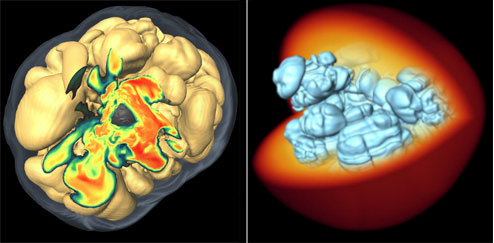
The MPA Supernovae group is a world-leader in modelling the violent deaths of stars in the form of supernovae and studying how such explosions produce the chemical elements, generate gravitational waves or can be used as reliable cosmic distance indicators. Massive stars end their lives in core collapse supernovae when the star has run out of nuclear fuel in the interior. In some cases the explosion following the initial collapse can lead to particularly energetic hypernovae or gamma-ray bursts. Another type of supernovae occurs in binary systems involving white dwarfs, the compact remnants of less massive stars. These thermonuclear supernovae explosion can either be triggered by accretion of material from a companion star or during the merger of two white dwarfs. The MPA group specializes in performing realistic multi-dimensional hydrodynamical supercomputer simulations of the different types of supernovae and gamma-ray bursts, which takes into account detailed microphysics such as turbulent flame propagation, neutrino transfer, magnetic fields and special and general relativistic effects. The supernova models are also used to predict the emergent spectrum to compare with observations.
Most of the work within the group is theoretical/computational in nature but more recently the group has lead several observational programs aimed at understanding the physics of supernovae. The group has a long track-record of developing novel and sophisticated numerical methods to enable the extremely computing-intensive hydrodynamical simulations. The group has excellent access to powerful parallel supercomputers and is involved in the long-term Collaborative Research Center
"Neutrinos and Dark Matter in Astro- and Particle Physics" (DFG). It also actively participates in the Excellence cluster on
Origin and Structure of the Universe involving MPA, MPE, MPP, ESO, LMU and TUM.
Research fields for which PhD projects are offered:
- Explosion physics of thermonuclear supernovae
- Simulating gamma-ray bursts
- Neutrino transfer and core-collapse supernova
- Supernova nucleosynthesis
- Modelling and observations of supernova spectra
- Gravitational wave signature from supernova explosions